 |
| Yes, please. |
3.05.2020

3.15.2018

7.19.2017

11.26.2012
Capitalist Tool: Anything by Wayne Thiebaud
 |
| Wayne Thiebaud, Ice Cream Cone, 1966 Painted cigar box, oil on wood, 5 3/8 x 2 5/8 x 2 1/2 inches (13.7 x 6.7 x 6.4 cm) Collection of Betty Jean Thiebaud. |
His work is affects me like a good therapy session.
10.20.2011

10.07.2011
Nörway Röcks!
Further to my odd fascination with Norwegian black metal, this week’s New Yorker magazine runs a great photo essay by photographer Peter Beste on black metal bands and fans. I think it is the incongruity with the light bright of Norway and the freakest bleakest aesthetic of these metal heads. And this isn’t just playing dress up, these fellows take the back metal philosophy way seriously. Hell hath no fury like a Norseman scorned?


6.29.2011
Giant Schnauzers
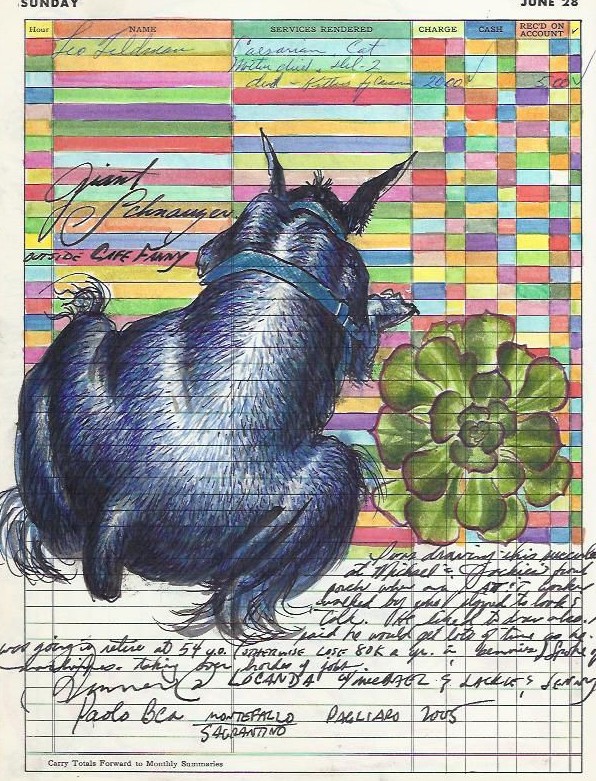 |
Big Dog, Fanny Cafe, Berkeley, Don ColleyI love Don Colley's work, mostly because it is so unabashedly disturbing, but this picture I thought was just lovely. It captures sitting outside in California, the terra cotta radiating the warmth of the sun. Colley is a wonderful sketcher, capturing faces, profiles, scenes in various stages of unaware. That his sketchbook is usually a found ledger adds to the spontaneous feel. Check out his website: http://buttnekkiddoodles.com/ . |
4.05.2011
Capitalist Tool: Camper Bike and Camper Kart
Fueling those escapist fantasies, Kevin Cyr just made getting away from it all a whole lot easier. Be sure to check out the cozy interiors! www.kevincyr.net
(via SwissMiss)
 | |||
| Kevin Cyr, Camper Bike |
 | ||||
| Kevin Cyr, Camper Kart |
(via SwissMiss)
2.15.2011
Things are not always as they seem ...

When I first saw this, I thought it was a very pretty Donald Sultan-y watercolor. Turns out that it is Neisseria gonorrhoeae--or, Gonorrhea bacteria. Who know VD could look so pretty? (PopSci)
11.18.2010

11.02.2010
War Dead

Canadian designer Kamel Makhloufi’s pair of stark graphs effectively visualize the human toll of the Iraq war.
Each pixel represents a death: U.S. soldiers = blue, Iraqi troops = green, enemies = grey, and civilians = orange. First image is function of sum, second image is function of time
(thanks to Data Pointed )
10.12.2010
Albanian Vendetta
 |
| Shkodra. Guillaume Herbaut |
10,000 people are affected by vendettas in the North of Albania, living shut away for fear of reprisals from the opposing family. 1000 children do not leave home and no longer attend school. 2000 women have lost their husbands in the settling of scores. The fall of the communist dictatorship in 1991 led to the reappearance of earlier practices. The Kanun, a civil code drafted by Lek Dukadjini, a lord of the North in the 15th century, has extended its influence in a time when the voices of the police and the judiciary are inaudible. The Kanun strictly codifies revenge. If one of its members is killed, a family must take revenge. – Bruno Masi

These photos were taken in 2006.
 | ||
| "One of us is going to die." Hysni Ymeri has lived shut away with his son Alban for the last three years |
9.30.2010
Babu, Varanasi, 2000.

Dasaswamedh Ghat
“What’s your name?” I asked him. “Babu,” he told me. I told him mine, and said, “Come, let’s sit down.” So there we sat, on a bench on a dais on the banks of the Ganges, just chatting. His family lived down the way, he was about seven, he had a little sister, he went to school. I told him about myself a bit, finding I was more at ease with this kid than pretty much anyone I had yet to talk to on my trip. The conversation came to its natural end, and we said goodbye. I thought what a neat kid, what a neat moment, and went about my afternoon wander. Not really looking too far back.
The next day, and over the next few days, he was there again, playing with some friends on the ghat not too far from where I was staying with my friend. I found that I was truly happy to see him as “Hey! Babu!” shouted from my mouth. He came over, said hey, asked what I was up to, and then went back to his friends.
One night there was a music festival at the main ghat, and my girlfriend and I were sitting there, getting situated, and there came Babu with his friends, all of them, boys and girls, around the same age, seven or eight, shoeless, clothes filthy and threadbare, playing games around, over, between and basically on top of me and my friend. It was pretty silly, and I remember that whole evening as a wonderfully happy one, with incredible music in the air, candles and marigolds floating down the river, and these kids playing all around us.
We were set on leaving Varanasi soon; we had been there for almost ten days and still had a lot of miles ahead of us. This kid had gotten under my skin. As pathetic as it may sound, I found that this seven-year-old kid made me feel relaxed and happy. Since I said no to the first postcard, he never once tried to sell me anything or persuade me to go to a certain vendor or any other scheme. He seemed to have no agenda beyond hanging out. I hadn’t appreciated how guarded I had become over my time traveling, the 5’8” blond part of a two-woman unit traveling the subcontinent. Even after we got whisked away for two days by a rogue taxi driver the second we got off the plane in Delhi, I never got used to what easy mark we were.
Before we left, I wanted to do something for Babu. He was obviously very poor. I wanted to buy him some new clothes, take him to eat until he was stuffed, buy his books for school, do something. My girlfriend counseled that he already had a family; it wasn’t my place. True. Who was I to assume? But I had so much comparatively and he had so little—and he had given me so much. I wound up asking if I could take his picture—and for that I gave him a 20-rupee note, which was the largest bill I had on me.
I still look back and feel conflicted. My time and conversations with Babu are some of the strongest, and fondest, memories of my time in South Asia, and have stayed with me in a more meaningful way than the inevitable anecdotes born from two months on the road. Sometimes I wish I had drowned out the mental politics around the rich white westerner and the relativism and the propriety and myopic presumption therein and taken the kid to lunch and said thank you for being my buddy. If I could do it again, I think I would do just that. And buy up every last post card he had.


9.20.2010
Annapurna foothills, 2001
 |
| Annapurna foothills, 2001 |
Because I need something pretty today.
Sunshine, Himalayas, and marigolds.
Subscribe to:
Posts (Atom)